Marvel Vs. DC, Part 3: The Main Event
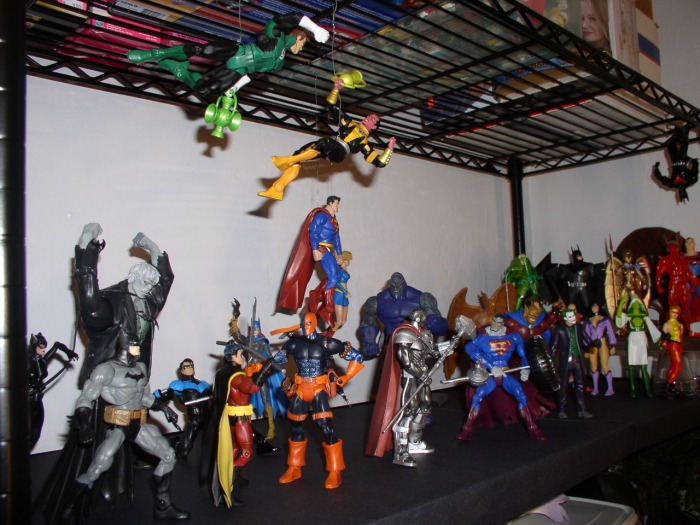
We're taking a look at Marvel and DC figures. In part one, we looked at figures that fell beneath three inches. In part two, we stepped up a little, looking at toys that ranged from a three to five inch scale. And next time, we'll be looking at some figures that stand eight inches and up.
But now - right now - it's time for the main event. Hold on to your hat, because it's time to turn to the coveted six and seven inch scales. And that means looking at Marvel Legends and DC Universe Classics, two very large, very famous series that command a great deal of loyalty from their fans.
Marvel Legends have been coming out for years. Originally produced by Toy Biz, these have since been picked up by Hasbro. These are notable for really rising the bar on what could be expected from mass market superhero figures in this scale.
Overall, I really like this line, particularly when made by Toy Biz. The sculpt and paint work here was way ahead of its time, but that's not why these are spoken of in hushed, reverent tones. No, what really makes these stand out has nothing to do with the figures themselves: it's all about the accessories. These came with bases, vehicles, weapons... whatever made sense or just seemed cool.
But that's just the beginning. Marvel Legends perfected the art of the "build-a-figure." Were they first? Nope. But saying they did it better than anyone else is an understatement: these are, for lack of a better word, ridiculous.
I mean, absurd. As cool as a wave of Marvel Legends figures are, put them next to a completed Sentinel or Galactus, and THEY start looking like accessories. I've got a Sentinel which I picked up a few years ago on Ebay. He's awesome. Simply awesome.
But how do the figures measure up? Well, that depends on the figure. As a rule of thumb, the best of these have a coat or something at their sides. Why? Because, for all Marvel Legends got right, there's one thing they never figured out. And that's the human waist.
I appreciate the difficulty: I really do. While the 'T' joints used by a lot of larger figures look nicer, you lose A LOT of movement. Ball joints provide a far greater range of motion, but there's a price. And that's appearance. The hips of Marvel Legends figures are atrocious, just awful compared with the rest of them. But this is a line partially defined by articulation: what are you going to do?
Well, for a lot of figures, it isn't an issue. Characters like Gambit have a coat that covers his hips entirely. Weapon-X (pictured below) isn't quite as lucky, but his sensors provide enough distraction to make the figure look good. Likewise, robots and other characters made of metal look alright, at least to me.
But, frankly, a lot of other characters just don't work. The worst are the women: I've reviewed The Black Queen (made by Hasbro, incidentally), if you want to revisit a train wreck.
Of course, it's not like there's anything anyone could have done to fix the problem, right? Right?
That brings us to Mattel's line of DC Universe Classics.
Originally, these were sold as DC Superheroes, but they're basically the same (likewise, the Dark Knight "Movie Masters" line is more or less interchangeable). I use the DCUC label interchangeably with Mattel's other DC offerings in the same scale, and I've seen other collectors do the same.
In many ways, DCUC are similar to Marvel Legends: great sculpt, great paint, great articulation... but there were a few changes. The most important being the hip joint. Rather than use a ball joint, Mattel created something completely different and surprisingly inventive. It's sort of a variation on the old 'T' joint. But there's an added hinge joint that lets the leg swivel outward in addition to back and forth. While doing a split, the hinge is visable, but put the legs together, and it disappears. You get the best of both worlds: ingenious!
That said, some of the articulation on the DC Universe Classics is more limiting than on Marvel Legends. Some Marvel Legends figures had individual finger joints, for crying out loud: DCUC uses sculpted hands. Likewise, the "toe" articulation is gone, and the elbow/knees are reduced to a single pin each.
While I do miss some of those joints from time to time, overall I far prefer the simplicity of the DC Universe Classics articulation. The loss of a few joints is a small price compared to the display potential offered by the DCUC figures.
Mattel has also "borrowed" the build-a-figure concept, though it's named "Collect-and-Connect" here. Once again, when you buy a wave, you get the pieces to put together a larger figure... just not as large as with Marvel Legends.
I've reviewed Solomon Grundy, who seems to be one of the better offerings. As a figure, I like him a lot. But he's no ML Sentinel.
So, personally, I think Mattel's DC Universe Classics are better figures, but Marvel Legends - particularly under Toy Biz - came with better accessories.
For those looking to start a collection in this scale, right now you're way better off with DC Universe Classics. These are still available at toy stores. I even see some of the early lines from time to time.
If you want Marvel Legends, you've got two choices. These are still in production by Hasbro, but most collectors seem to agree they're not quite what they once were.
You can pick up the old Toy Biz figures, but don't expect them to be cheap. Even used, these often cost a pretty penny on Ebay.
Mattel Solomon Grundy, Sinestro, Catwoman, and Deathstroke with DC Direct Lex Luthor and Joker. The scale's off a bit, but not enough for me to care.
While this pretty much sums up the six inch figures, they've got bigger relatives. If you're looking for something a little more statuesque, both Marvel and DC have characters in a slightly larger scale.
Marvel Select Phoenix which has since been improved.
Marvel's offerings in the scale are a bit more limited. A line of "Marvel Select" figures have excellent sculpts and paint work while having very limited articulation.
The biggest problem with this series is the size: there just aren't a lot of these figures produced and sold. For those of us who like to assemble an army of costumed heroes, this is kind of a dead end. But if you're looking for a single piece, these are a pretty good deal for your money. They look similar, in some respects, to the more expensive statues that go for three or four times as much.
DC's seven inch figures are decidedly more complicated. DC Direct produces a large number of figures in this scale aimed directly at collectors. There are more series and waves than I'd care to try and count.
Some of these are amazing figures, representing top-notch sculpting, a full coat of paint, good accessories, and decent articulation.
The problem is that some... are not.
On one end of the spectrum, there's the line of Kingdom Come action figures: breathtaking examples of collectible art. On the other, you've got figures that look like they were sculpted by a twelve year old. I can't provide many examples of the low points DCD can sink to - I only buy figures I like, of course - but take a look at the toys the next time you're in a comic store: you won't believe some of these are from the same company.
Most of the time, you can see what you're getting into by glancing at the figures. But, if you're collecting DC Direct figures you also need to be aware that there are unforeseen problems.
I've had more issues with DC Direct figures than any other company I can think of. Arms falling off, leg joints snapping, wings breaking... you name it; I've seen it.
Does this mean you shouldn't buy these? No: for all these problems, I've got dozens of figures that works like they're intended. Just be aware that there's a risk involved.
As a rule of thumb, I've never had problems with a DC Direct figure that came packed in a box. It's the ones that came carded that have given me trouble (I have no explanation for this, but it's been true so far).
Also, if scale is important to you, take a good look at the size of the figure. These are really only seven inch some of the time: some are smaller than others.
As a final note, DC Direct figures have an odd tendency to find their way to the clearance shelves. They don't all wind up in this fate, but it's a great way to start a collection.
We've got one more article to go: the Big Leagues; a discussion of figures eight inches and up.



